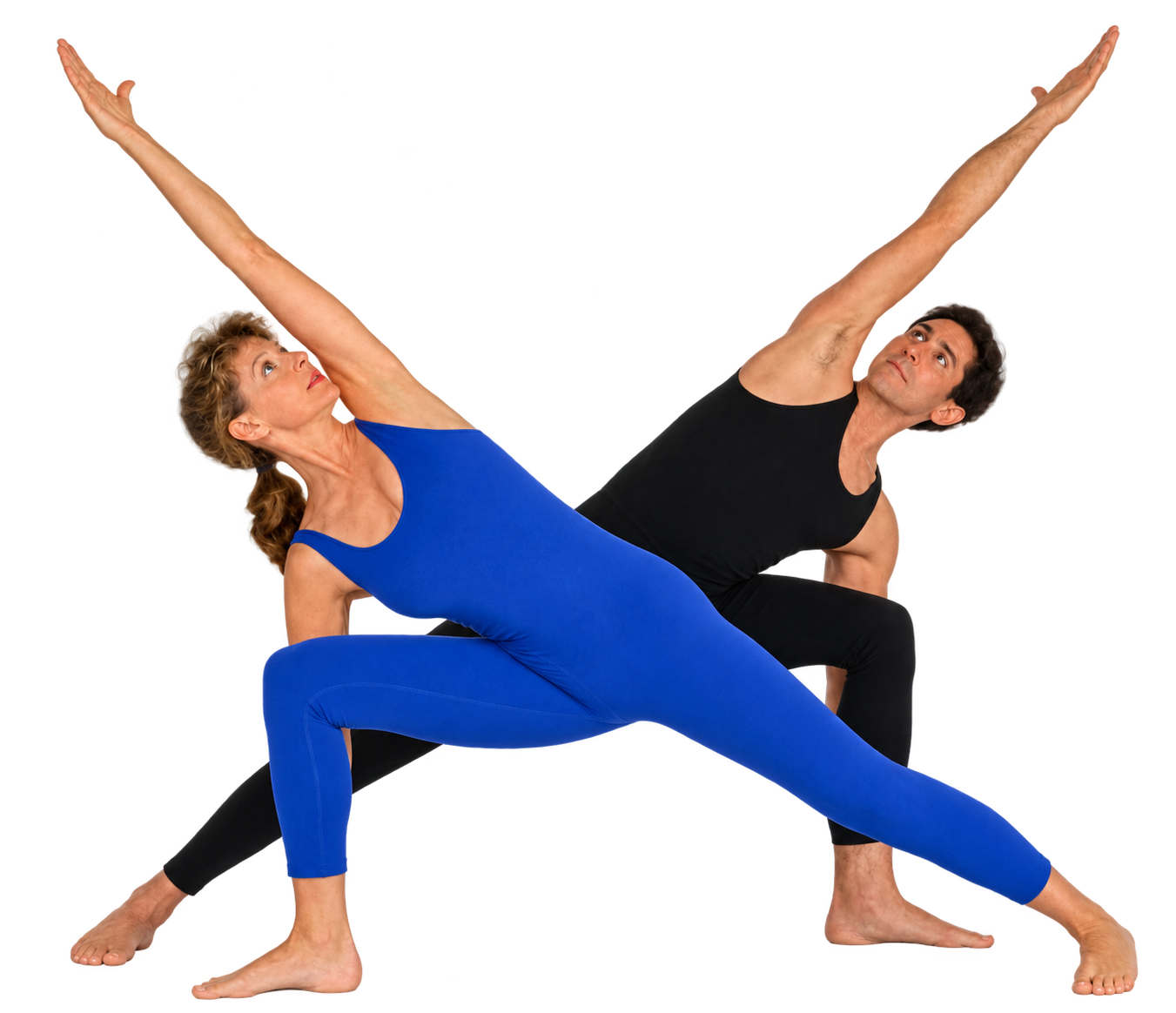
Yoga as the Universal Body Conditioner
A foundational principle of exercise science is that physical adaptation occurs only in the specific body systems that are directly stressed during exercise.
For example, running produces favorable adaptations in the legs, heart, and chest wall, which directly improve running capacity. This response is known as the training effect. Systems that are not stressed show no adaptation; even heroic amounts of running will produce virtually no structural or functional changes in your arms. While the adaptations from running may transfer slightly to other leg-centric activities, such as cycling, that crossover remains surprisingly limited.
Understanding the training effect raises a crucial question for athletes and active individuals: how do specialized workouts or sports actually translate to overall, whole-body health?
The Limits of Specialized and Traditional Training
Many people turn to specific sports, conventional weight lifting, or gym machines to stay in shape. However, traditional strength and athletic training are extremely movement-specific.
For instance, performing isometric biceps exercises at a fixed 90-degree angle transfers surprisingly poorly to strength when the elbow is bent at 60 degrees. Executing arm curls at a slow, deliberate pace yields minimal improvement when you suddenly need to move quickly.
Even simple grip strength exhibits remarkable specificity based on wrist and elbow position, hand placement, and whether your hands are working above or below your head. Consequently, simple repetitive habits—like squeezing a rubber donut while driving—provide virtually no functional benefit for varied physical demands.
Traditional athletic conditioning and bodybuilding programs rely heavily on repeating the exact same isolated, symmetrical movements over and over in a single plane of motion. But real life—and dynamic sport—rarely happens in straight, predictable lines. Reaching, twisting, bending, and reacting require your muscles, tendons, and fascia to produce force at unpredictable angles and in asymmetrical positions that are almost never practiced on standard gym machines.
The Need for Movement Variation
When you train using rigid, repetitive movements—or—focus exclusively on a single sport, you condition your body to be strong only within those narrow lanes. To build functional resilience, movement patterns must be intentionally varied.
It is also important to recognize the difference between functional capability and unnecessary mass. Building excessive, bulky muscle mass in isolated areas often creates joint strain and chronic tightness. When athletes experience stiffness or hit a physical plateau, they often assume the problem stems from a lack of strength. Far more often, the real barriers are inflexibility, poor coordination, and a lack of systemic balance.
Ultimately, the training effect reveals a fundamental truth: your body adapts precisely—and strictly—to how you use it.
Because most athletic pursuits stress only specific muscles through repetitive ranges of motion, they inevitably leave other parts of the body undertrained, overtightened, or structurally imbalanced. Running tightens the hamstrings and ignores the upper body; weightlifting often shortens muscle fibers and stiffens the joints; racket sports create one-sided muscular asymmetries.
This is precisely why yoga, when appropriately practiced, serves as the ultimate all-around body conditioner.
Unlike linear gym workouts or specialized sports, yoga works the body as an integrated whole. It moves every joint through its complete, natural range of motion, hydrates the fascial network, and balances opposing muscle groups. By pairing non-forceful movement with conscious breath control, yoga restores the flexibility, joint stability, and micro-circulation that specialized athletics drain away.
In the final analysis, athletes of every discipline—whether runners, cyclists, lifters, or weekend warriors—will profoundly benefit from incorporating yoga into their regimen. It does not replace your primary sport; rather, it undoes the rigid repetitive strain your sport creates. By bridging the gaps left by the training effect, an appropriate yoga practice creates a resilient, balanced, and fluid body that performs better, avoids injury, and lasts a lifetime.