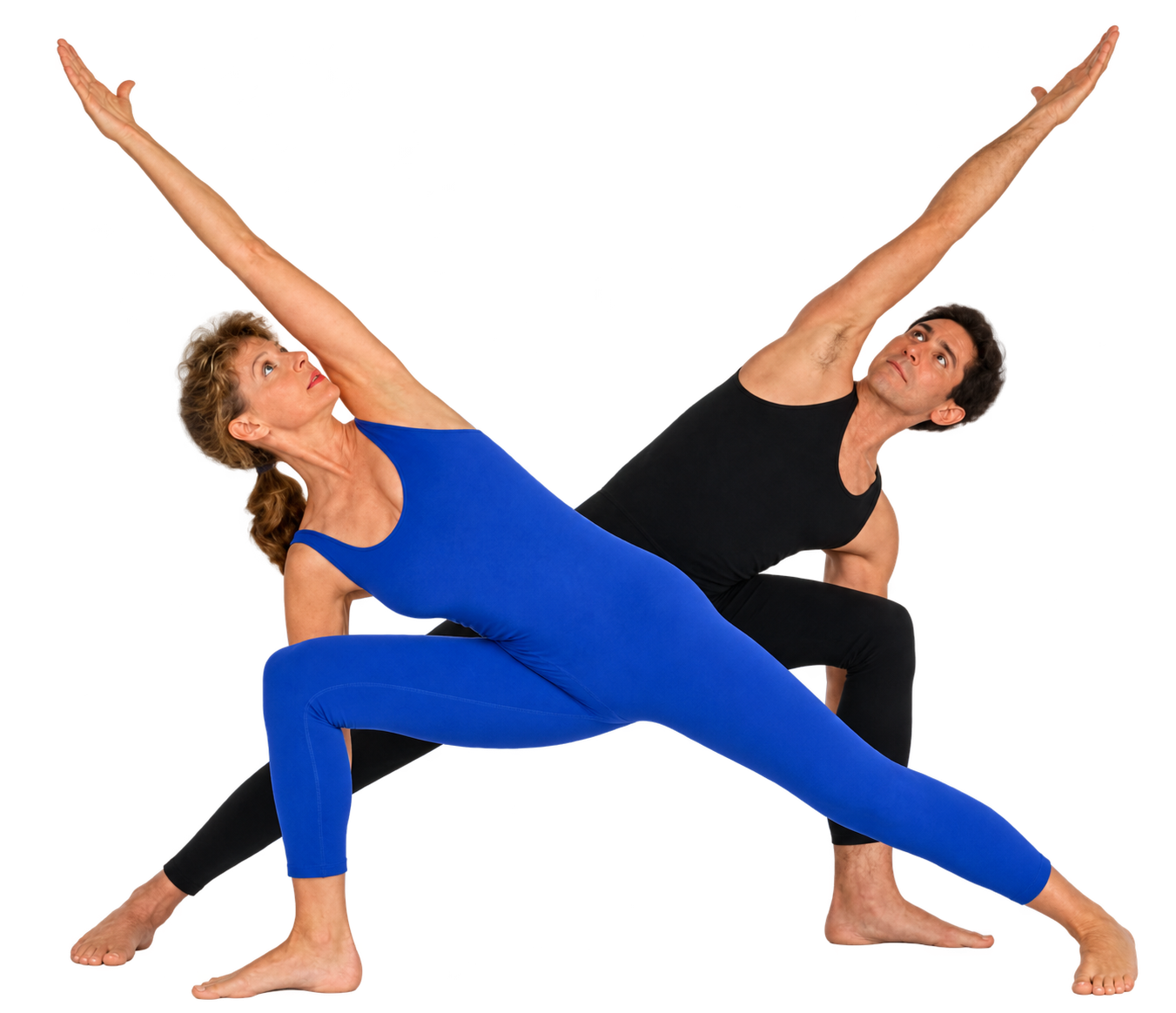
Intense Yoga Exercise as We Age
I know a 48-year-old man who has been practicing extreme yoga for 30 years. If you saw him practice, you’d call him "Gumby." But he isn't just remarkably flexible—his high-intensity, aerobic style of yoga regularly leaves other athletes who try to do what he does, sweat-drenched and exhausted.
Yet he has a major problem. After years of extreme yoga, he lives in chronic pain. He reached out to me for advice because he felt his style of aerobic yoga had ultimately failed him.
He had come across my website, where I explain the mechanics of an "appropriate yoga practice" and the logic behind the principle that less, done correctly, gets you more. He read how chronic pain tightens the body, along with the physiological mechanisms that make exercise increasingly difficult as we age.
Because of his age and chronic pain, he assumed he needed to abandon his advanced aerobic practice altogether, slow down, and practice with far less intensity. “In other words,” he told me, “my goal now is to learn ExTension Yoga because I believe it’s healthier than what I’m currently doing. My goal is no longer to do advanced yoga, but to be able to do yoga at an advanced age.”
My response surprised him. Here is what I told him:
Learning ExTension Yoga can certainly take your practice in a new direction, but you don’t necessarily have to give up aerobic yoga.
ExTension Yoga students learn proper body mechanics and the functional differences between muscles, tendons, ligaments, and fascia (collectively known as soft tissue). They learn how stress tightens soft tissue—especially in aging bodies or those dealing with chronic illness and injury. They also learn the critical difference between ‘trying hard’ and simply ‘doing,’ and how that distinction affects soft-tissue stress.
By applying these concepts, students learn to adapt their movements in a way that minimizes stress and maximizes potential. Yoga becomes a thoughtful process of doing rather than trying. It teaches you how to move non-aggressively toward a boundary rather than pushing recklessly to it. The result is a practice that reduces inappropriate stress while allowing us to maintain strength, endurance, and flexibility as we age.
In other words, practicing ExTension Yoga doesn’t mean you have to forgo jumping, sweating, or vigorous movement. Nor does it mean you are forced to practice slowly and softly forever. It means learning how to consciously adapt your practice on any given day so you don't hurt yourself.
I offered my own situation as a personal example. I have multiple sclerosis, and I can never predict how it will affect my body on any given day. When I feel well, I can practice advanced, energetic yoga. But when my MS symptoms flare up, advanced yoga isn't just difficult—it's nearly impossible as well as dangerous. On those days, I return to foundational work: minimal movements paired with controlled breathing.
Even though I am nearly 60 and living with a major chronic illness, my overall exercise capacity exceeds that of most 40-year-olds—even when I am unable to sustain vigorous practice for extended periods.
How is that possible? An appropriate ExTension Yoga practice stimulates the nerves, organs, and glands while conditioning the primary structural, circulatory, respiratory, and digestive systems. Most importantly, it accomplishes this without over-stressing the body, allowing you to maintain true physical fitness regardless of how intensely you practice on a given day.
As I concluded to him: "It isn't the quantity or brute force of doing yoga that yields results—it is the quality of the practice."